
Indians in Malaysia: Masters of Division, Champions of Self-Sabotage
FEATUREDCOMMUNITY
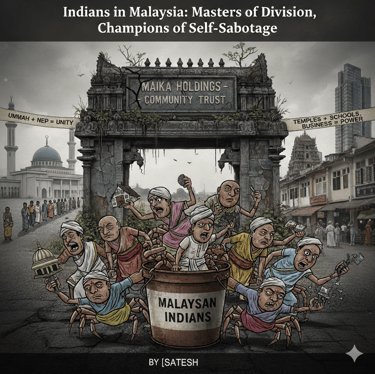
Beyond the "crab story": A critical analysis of Malaysian Indian unity and a roadmap for business-led growth, education, and financial accountability.
Let’s be brutally honest. Malaysians are a multicultural mix, but while Malays and Chinese figured out how to stand together, Indians are still busy tripping each other up. (The classic crab story)
The Malays? Simple. Islam is their glue (the Ummah). Add the New Economic Policy (NEP) after 1969, which basically handed them education slots, jobs, and business opportunities, and you’ve got instant cohesion. Religion plus government perks equals unity.Malays got too much to loose by separation, and their political parties never fail to remind them of this, much to the detriment of others.
The Chinese? They built temples, schools, and business networks. Temples keep the faith alive, schools keep the language alive, and business keeps the money alive. When it’s time to rally, they move like a well-oiled machine. Do they have their internal squabbles? Yes they do, but that’s the thing… its INTERNAL. Do they have different dialects, religions, motives and political parties? Yes, they do, but they are Chinese first and others later.
Meanwhile, there’s us Indians. We are still arguing over which dialect sounds superior.
China had its big “one emperor to rule them all” moment in 221 BCE when Qin Shi Huang unified the country. He standardized script, currency, laws, even wagon axle widths. That’s how you build a nation. India? Never bothered. Languages, castes, religions, kingdoms everyone wanted their own spotlight. Till today this is still an issue in India. They cant even agree on a national language. In some states you get trashed for not speaking the local dialect. Idiots refuse to share water across state while the central government helplessly watch.
And guess what? Indians in Malaysia dragged that fragmentation along like excess baggage. Tamil, Malayalee, Telugu, Punjabi. We cling to our mother tongues like they’re sacred relics. Instead of blending, we bicker. It’s not pride it’s disdain. Sometimes I think we hate each other more than we hate paying taxes. Even today I have aunties that ask , are they also Mallu? There are still families that will disown you for marrying across this divide in 2026, in Malaysia. That said, somehow this logic does not apply when the other party is White ! Rules don’t apply to our Ex Colonial Masters apparently. In fact you will be held in high esteem for bagging a white girl or guy. Probably because there are chances that the kids skin can be white (don’t get me started on this ). Exception is also granted if the other party is rich or live in US or Europe. You will see this in many Punjabi families. If he has money he is not a 'Thawa'.
Caste? Still alive, still toxic. The eternal question: “What people are they?” Even leaders like Pandithan and Samy Vellu couldn’t unite because caste politics stood in the way. I have seen people refuse to eat or drink at certain houses because of this , this is even hard to whitewash with money. There are people that are prominent Dato’s but they don’t command respect because of their caste.
Religion? Hindus, Muslims, Christians, seculars. Each group pulling in different directions. Some Muslims crossed over to UMNO and became Malay, I don’t know how a “mamak” can be part of a Malay organisation. Worse still he will go there and be more Malay then Malays themselves. Case in point our past Prime Minister. In fact he redefined what being Malay is by changing it to something related to religion, language and customs. Opening up the door for others mamaks to follow suit.
Christians Indians on the other hand act like honorary Europeans. These Macaulay Putra feel adopting their colonial masters name and religion, makes them holies us savages. While eating sambar at home, they come out with Oh we are not like them. Just see some comments in social media, they will join other races to whack Hindus at the smallest of opportunity. These Tea Buns are the worse of the lot playing both sides of the spectrum.
In Hindus we are split by sects and temple politics. Even in temples we have team A and team B.Basically, we’re a religious buffet with no main course.
And our politicians? Forget unity. They’re too busy counting their own money. Let’s talk about Maika Holdings, the so-called “investment vehicle for Indians” launched in 1983. It raised RM106 million from 66,400 mostly poor Indian investors. What happened? RM144 million allegedly vanished, lawsuits piled up, and the whole thing became a scandal that symbolized betrayal of the very community it was meant to uplift. Then there’s AIMST University, launched under MIC’s Maju Institute of Educational Development. It was supposed to be our pride, a state-of-the-art private university. Instead, it became a symbol of mismanagement, struggling to deliver on its promise while Chinese institutions flourished. And don’t forget TAFE College in Seremban. Once touted as the gateway for Indian youth into technical education, it eventually declined, underfunded and unable to compete, leaving behind a legacy of wasted potential.
See the pattern? Every time we try to build something, we sabotage ourselves. Bogus chili plantations, failed telecom shares, collapsed colleges. It’s like we’re running a masterclass in how to shoot ourselves in both feet and then complain we can’t walk. It’s as if selfishness is hardwired into us. Always thinking there’s not enough, so we grab whatever we can, even if it means tripping our own people.
Politicians won’t save us. They’re too busy saving themselves. The real hope lies with business leaders but not the ones who think running a plantation scheme (chili) counts as innovation. I mean real leaders who understand scale, accountability, and sustainability. Here’s what they can do:
Education: Build independent, audited foundations that fund scholarships, technical training, and proper universities. Not vanity projects with marble lobbies, but institutions that actually produce graduates who can compete. If the Chinese can run entire networks of schools, why are we still crying over TAFE’s ghost?
Investment Platforms: Create transparent, professionally managed funds audited annually, with clear reporting, so ordinary Indians can invest without worrying their money will vanish into someone’s Swiss account. Think less “Maika scam,” more “community trust fund.”
Entrepreneurship Hubs: Indians in Malaysia are scattered across small businesses—restaurants, shops, services but there’s no coordinated ecosystem. Business leaders could build incubators, mentorship programs, and cooperative networks that pool resources. Instead of fifty people running fifty tiny shops, imagine fifty people running one scalable enterprise with actual bargaining power.
Media and Narrative Control: We don’t just lack institutions, we lack a story. The Jews didn’t just build banks; they built narratives that positioned them as indispensable. Business leaders here need to invest in media, think tanks, and cultural platforms that tell our story, shape perception, and stop us from being seen as fragmented leftovers.
Accountability: Every institution must be audited, transparent, and run like a business not like a politician’s side hustle. No more “shares for the community” that end up funding someone’s bungalow.
And spare me the “we’re too small” excuse. The Jewish community is tiny in numbers but massive in influence. They built institutions, shaped narratives, and influenced global economics. Indians in Malaysia could do the same if we stopped fighting over language, caste, and religion.
Until Indians in Malaysia learn to stop being their own worst enemy, we’ll remain the punchline in Malaysia’s multicultural drama. Unity isn’t about numbers, it’s about discipline, focus, and building institutions that last. Right now, we’re not even close.