
Hegemony or Realignment? Decoding the Quiet Transformation of Malaysian Politics 2026
FEATUREDMALAYSIAKU
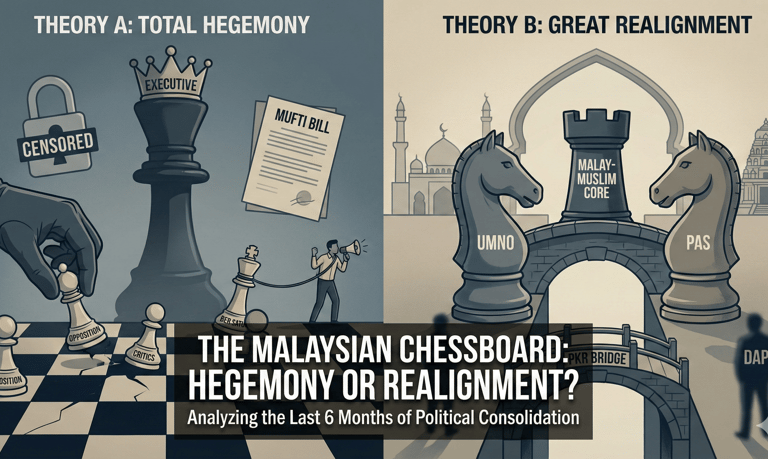
The two theories behind Malaysia’s recent political shifts: a tactical executive power grab or a massive realignment between UMNO, PKR, and the Opposition.
If you’ve been scrolling through your feed lately, you’ve probably felt that familiar "here we go again" sensation. But let’s be real the last six months in Malaysia haven't just been the usual political noise. It feels like we’re watching a high stakes chess match where the grandmaster is suddenly clearing the board, and not everyone is invited to the next game.
Between the sudden sacking of Hamzah Zainudin (who was literally the Leader of the Opposition until a few days ago), the legal "leash" tightening around Rafizi Ramli, and the new federal stance on unauthorized temples, the pattern is getting impossible to ignore.
So, what’s actually happening? Depending on who you ask at the mamak, there are two big theories.
Theory A: The "Total Hegemony" Play
In this scenario, the goal is the systematic elimination of every single threat internal or external to create a singular, unchallenged executive authority. Think of it as a "political vacuum" strategy.
First, the centerpiece is the decapitation of the opposition. By facilitating the collapse of Bersatu, the executive has effectively removed its most dangerous strategist. The February 13th sacking of Hamzah Zainudin, along with 16 other senior leaders like Wan Ahmad Fayhsal, didn't just hurt the party; it left a massive leadership vacuum that Takiyuddin Hassan and PAS are now scrambling to fill. A fractured opposition is a harmless one.
Second, you have the "Internal Checkmate." Look at Rafizi Ramli. He’s always been the "internal rebel," joining the #TangkapAzamBaki street protests on February 15th to demand the MACC chief’s resignation over shareholding allegations. But just as Rafizi starts getting vocal, an RM1.11 billion MACC probe lands on his own desk. Whether it’s valid or not, it’s a masterclass in neutralization. It keeps him defensive and signals to everyone else: play ball, or play defense in court.
Third, the state is building a narrative shield. The Mufti (FT) Bill 2024 and its binding fatwas, alongside the CMA Section 233 amendments that now criminalize "grossly offensive" content, aren't just policies. They are the tools for a new "Social Contract." Toss in the Citizenship Bill controversy regarding foundlings and the Online Safety Act, and you have a state that can define exactly what "stability" looks like while scrubbing 8,100+ dissenting posts from TikTok.
Theory B: The "Great Malay Muslim Realignment"
This theory suggests we aren't seeing a takeover, but a massive realignment. It’s the birth of a new Malay Muslim super majority that bridges the government opposition gap, effectively making the "Reformasi" movement and the DAP irrelevant.
This isn't new. In the early 70s, after the chaos of '69, Tun Razak brought old rivals into the BN fold. This feels like Version 2.0. Ahmad Zahid Hamidi extending an "olive branch" to Khairy Jamaluddin (KJ) at the January assembly and Akmal Saleh openly calling for a Muafakat Nasional 2.0 with PAS are the breadcrumbs. Even PAS has signaled an "open door" policy, essentially saying the "Grand Collaboration" is on the table.
In this world, PKR undergoes a "controlled purification." With the reformists sidelined, the party becomes the "Executive Bridge" the moderate glue that allows UMNO and PAS to merge without looking too radical. Meanwhile, the "DAP" friction (over UEC, matriculation seats and university placements) and the crackdown on vernacular signage by local councils serve to show the Malay base that the government is "firm."
Look at the social triggers:
The GARAH anti temple protests and the subsequent arrests of Urimai leaders like Satees Muniandy show a state that will suppress both sides to claim the middle ground.
The UiTM "Bumi only" protests in January were met with a firm "no" to any inclusivity, a clear win for the nationalist base.
Even in Sabah, the fallout from the "Kinabalu Move" and post election friction shows a push to bring East Malaysian politics back under a central, stable command.
The Outcome: A New "Sheraton" but Tactful
Whether it’s one man building a fortress or a group of old rivals deciding to share the kingdom, the outcome is the same. The Malaysia of late 2026 will look nothing like the dream we were once sold.
If this "tactful consolidation" is real, we’re moving toward a system where the "Opposition" isn't a threat it’s just a junior partner waiting its turn, while the "Putera TikTok" influencers and nationalist rhetoric are allowed to surge to keep the base motivated. The result? A political monolith where "Opposition" vs "Government" is just theater for the cameras, leaving the progressives and minority partners like DAP out in the cold.