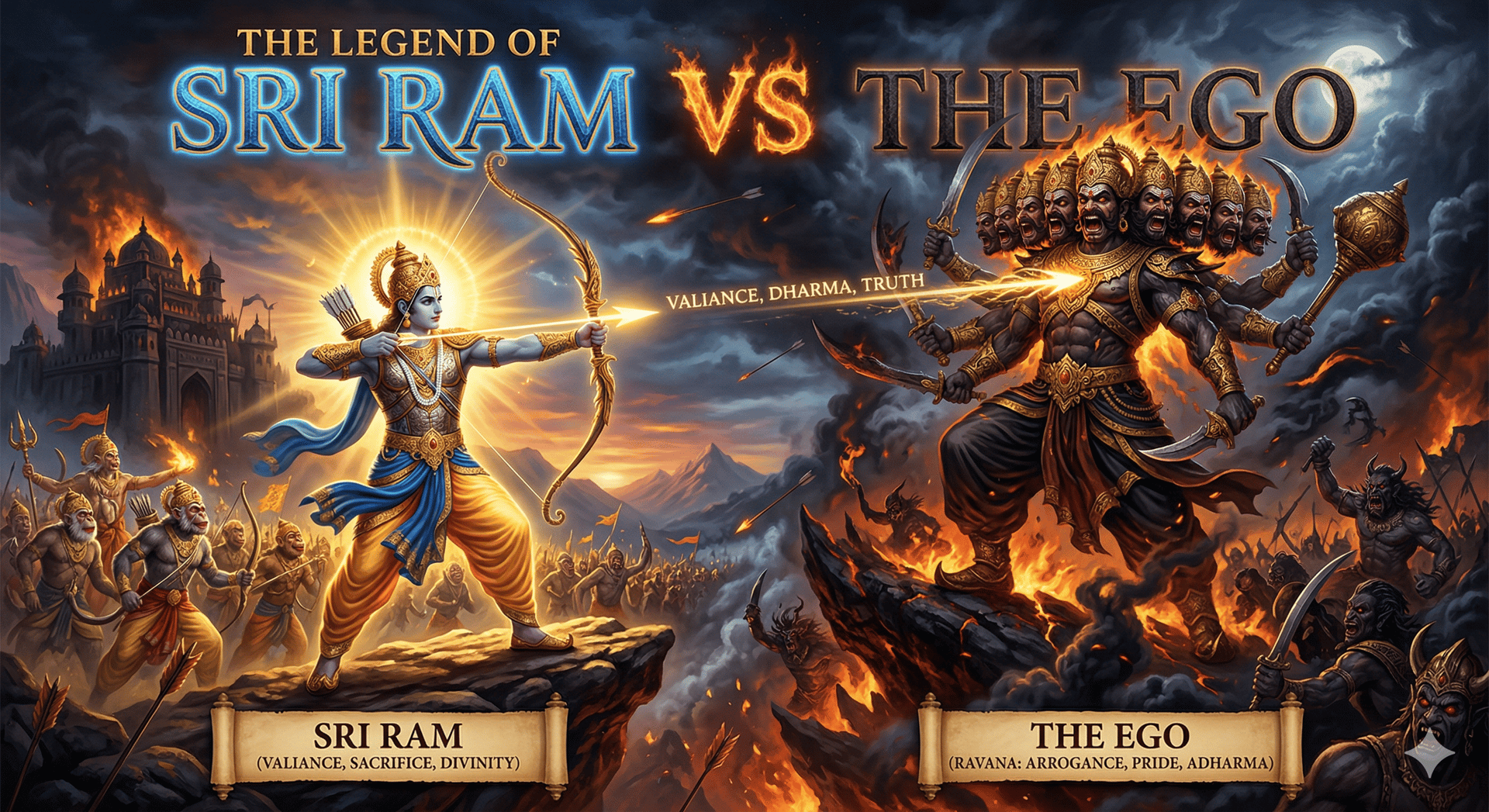
Ego Is the Enemy, Ram Navami, and What Corporate Life Taught Me About Both

CORPORATEFEATURED

Satesh

3/29/20265 min read

I finished reading Ego Is the Enemy the same week we celebrated the birth of the most ego-less leader in all of Hindu mythology. I don't think that was a coincidence..

Yesterday was Ram Navami. The birthday of Rama, king, husband, son, warrior, and in the Hindu imagination, the closest a human being has ever come to living without ego. He gave up a throne he had earned. He wandered forests he didn't deserve to be in. He led armies without ever making it about himself. When the victory came, he did not celebrate himself. He pointed upward.

I had just finished reading Ryan Holiday's Ego Is the Enemy the night before. And somewhere between the festival prayers and the last pages of that book, something settled in me that I have been trying to articulate ever since.

This is my attempt.

The book nobody wants to admit they need

Let me be direct about something. Ego Is the Enemy is not a comfortable read. It is not a motivational book. It will not tell you that you are special, that your instincts are right, that the world simply hasn't recognised your greatness yet. It will, in fact, suggest that this feeling, the feeling of unrecognised greatness is precisely the thing that is holding you back.

Holiday structures the book in three parts: aspire, success, failure. The idea being that ego attacks you at every stage. Before you achieve anything, ego makes you perform rather than prepare. After you achieve something, ego makes you believe your own hype. And when things fall apart, ego is the reason you cannot recover because recovery requires admitting you were wrong, and ego will not allow it.

The parts that hit me hardest were the second and third. Success and failure. Because I have lived in both of those rooms, and I recognised the furniture.

The managers I couldn't learn from

Years ago, at a different company, I had a manager who was not technically strong. I, on the other hand, had been in the industry for years. I knew the systems. I knew the processes. I knew or thought I knew what good looked like.

And so when that manager gave me feedback, I couldn't hear it. Not because the feedback was wrong. But because I had decided, somewhere in my head, that a person less technically capable than me had nothing to teach me. I rejected the signal because I didn't respect the source. I confused expertise in one area with wisdom in all areas. That is a very costly confusion.

This happened more than once. The pattern repeated across that season of my career until eventually the environment changed and I stepped away. And it was only in that distance that reset that I could see clearly what had happened. It wasn't that my managers were wrong. It was that my ego had built a wall around me, and I was calling it confidence.

I reached out years later and apologised. It was one of the more uncomfortable things I have done. But it was necessary, not for them, honestly, but for me. Because carrying the unacknowledged weight of ego is its own kind of punishment.

"My ego had built a wall around me. I was calling it confidence."

Work, credit, and the trap of ownership

The section of the book about work versus credit landed differently for me. Holiday talks about the danger of caring too much about who gets the credit for something, how that obsession corrupts the work itself, because you stop asking "is this good?" and start asking "will people know this was mine?"

I build a lot of things in my current role. Tools, systems, dashboards, automations. And sometimes people notice. Sometimes someone will say that solution is impressive, how did you come up with that? And I have to be very deliberate in that moment about what I let happen inside me.

Because here is what I have come to believe: when something I build works well, it is not because I am a genius. It is because I am a vessel for something that was available to anyone willing to stay curious, keep learning, and do the work without needing it to be witnessed. Like Socrates, who knew that the beginning of wisdom is knowing how much you do not know. I try to remind myself that the insight was always out there. I was just present enough to catch it.

It's the genie, not the genius. That is the line I say to myself.

"It's the genie, not the genius. The insight was always out there. I was just present enough to catch it."

— the line I now tell myself

Rama knew this. He always knew this.

This is why Ram Navami landed differently this year.

Rama is, in the deepest reading of the Ramayana, a study in ego-less leadership. He did not cling to the throne, the thing he had every right to claim,when asked to let it go. He did not demand recognition for the war he won or the evil he defeated. He governed not to be remembered as great but because governance was the dharma placed in front of him, and dharma does not care about your feelings about it.

He led without needing credit. He served without needing to be seen serving. He was, in Holiday's framework, the opposite of everything ego produces the entitlement, the defensiveness, the credit-chasing, the refusal to be taught by someone you consider beneath you.

I am not Rama. I want to be clear about that. I have an ego that still flares up. It still needs to be managed, not once but continuously. The book's phrase, not mine, but true: you do not sweep the floor once and call the house clean. You sweep it every day. Ego maintenance is a daily practice, not a one-time reckoning.

What this means in a corporate building in Malaysia

Here is the practical thing I take from all of this, sitting in a corporate role in Malaysia in 2026.

The most dangerous person in any organisation is not the one who lacks skill. It is the one who has enough skill to feel entitled who has done enough to feel that feedback no longer applies to them, that learning is for junior staff, that credit matters more than outcome. I have been that person. I have worked with that person. I have watched that person plateau and then quietly blame everything around them for the plateau.

The antidote and both Ryan Holiday and Lord Rama, twenty-five centuries apart, arrive at the same answer is to stay a student. Permanently. Not as a performance of humility, but as a genuine orientation toward the world. To understand that whatever you have built, whatever you know, whatever you have earned, it came through you, not from you. You were the instrument. The music was always larger than the instrument.

Supporting someone else's success, even when you could claim the moment for yourself that is not weakness. That is the move that compounds over a lifetime. Every person you genuinely help rise without extracting credit from the transaction is a deposit into something that pays returns you cannot see yet.

I finished the book. I sat with Ram Navami. And I thought about a manager I couldn't hear for too long, and the apology that came years too late, and the tools I build now that I try to hold lightly because the moment I grip them too tightly, I have stopped building for the work and started building for myself.

Sweep the floor. Stay the student. Let the credit go where it needs to go.

That is the practice. Not a conclusion but a practice.

Related Stories