AI Is Coming for Malaysian Call Centres First
CORPORATEFEATURED
I didn't set out to automate my colleagues out of a job. I just wanted to stop people from calling us to ask when their broadband was getting installed.
Let me be honest with you from the start. I am not a futurist. I am not a tech evangelist who flies to conferences and puts "thought leader" in his LinkedIn bio. I am a guy who has spent years inside Malaysian customer service operations, watching how things actually work the spreadsheets, the Outlook inboxes drowning in repeat queries, the agents answering the same five questions eight hundred times a day. And somewhere along the way, I started building tools to fix the parts that were obviously broken.
I did not expect it to add up to what it has become.
The conversation around AI and jobs in Malaysia tends to happen at two extremes. Either you get the doom camp AI is going to hollow out the middle class, call centres will be ghost towns by 2030, send your children to learn prompt engineering immediately. Or you get the dismissal camp. Malaysian workers are different, our culture requires human touch, technology will never replace real relationships. Both sides are wrong, and both sides are arguing about the future while the present is already happening, quietly, inside buildings you drive past every day on the LDP.
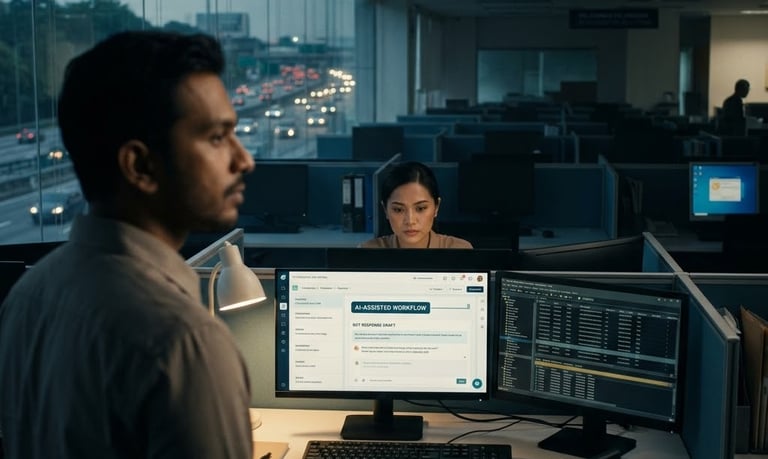
I know because I work in one of those buildings.
It started with a very unglamorous problem
The first thing I ever automated was not impressive. There was no machine learning involved. No large language models. No AI anything. It was a simple page a status tracker where customers could check where their broadband installation was in the queue. That is it. You enter your SO number, you see your installation date, you close the tab.
But here is what happened: the calls stopped. Not all of them, but enough of them. Because a significant chunk of what our contact centre was handling every day was exactly that question. "When is my broadband coming?" Multiplied by hundreds of customers. Every single day. Human agents, picking up phones, typing into systems, giving the same answer over and over information the customer could have found themselves if there was somewhere to find it.
That was the lesson I never forgot. The most powerful automation is not the one that replaces a complex human task. It is the one that eliminates a pointless human task that should never have existed in the first place.
The move to a ticketing system and why change is always "clunky" first
The next shift was moving from Outlook to a proper ticketing system. Now, to people outside customer service operations, this sounds like a minor administrative change. It was not. Our agents had built an entire working life around their email inbox. They knew where everything was. They had their folders, their rules, their colour codes. The muscle memory was deep.
When we made the switch, the feedback was immediate and unflattering. "This is clunky." "It is slower than just doing it from email." "Why are we changing something that works?" These were not unreasonable complaints. The tool was unfamiliar, and unfamiliar always feels clunky. That is just how humans are wired we confuse novelty with difficulty.
What happened next is the part I think about a lot.
Those same agents the ones who were the most vocal about how clunky the new system was — became its biggest advocates. Not because I convinced them. Not because I ran training programmes with motivational slides. But because once the automation started working, once the ticket routing was running, once the repetitive tasks were handled without them having to touch anything, they could see it. They could feel the difference in their own working day. Less noise. More time for the cases that actually needed a human being to think.
Nobody advocates for a tool they suffered through. They advocate for a tool that made their day better. That is the thing the anti-automation crowd never accounts for workers are not stupid. Given enough time and a genuinely useful tool, they adapt. And then they defend it.
"Nobody advocates for a tool they suffered through. They advocate for a tool that made their day better."
14 days to immediate. Let that land.
Here is the number that still gets me when I say it out loud.
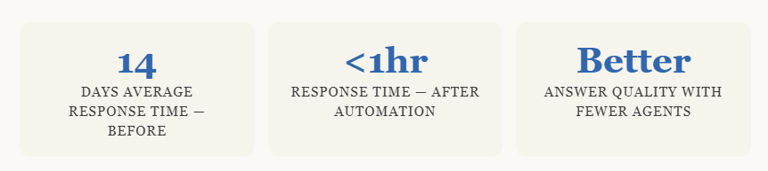
Before we introduced the email bot and agent-assisted response system, our SLA the time it took to respond to a customer query was sitting at 14 days. Fourteen. If you emailed our customer service team on a Monday, you might hear back two weeks later. That is not a customer service operation. That is a waiting room with no chairs
.
Today, that same query gets a response that is immediate for straightforward cases, and substantially faster for anything that needs a human to review. And we are doing this with fewer people than before. Not because we fired anyone. But because the headcount required to run the same volume of work shrunk naturally, over time as automation absorbed the repetitive load. The people who stayed are handling better work. More complex cases. More judgment-required situations. Less copy-paste.
That is not a tragedy. That is an upgrade. For the customer and, honestly, for the agent.
So is AI going to kill Malaysian call centre jobs?
Here is my honest answer, from someone who has been inside this for years: not in the way the headlines suggest, and not as quickly as the panic implies but yes, the shape of the job is changing, and pretending otherwise is dishonest.
The average Malaysian call centre today employs a lot of people to do tasks that, if you described them out loud, you would immediately see could be automated. Read this email. Classify what the customer wants. Copy the information into this other system. Send a template reply. Escalate if it matches these criteria. That is a workflow, not a vocation. Workflows get automated. That has always been true we just have much better tools for it now.
But here is what I have seen, and what I genuinely believe: when you take that work away from agents, you do not get unemployed agents. You get agents who finally have time to do the things that actually require a human. The complicated billing dispute. The customer who is genuinely distressed. The case that does not fit any of the templates because it is actually unusual. That is where the value is. That is where no chatbot is going to replace you anytime soon.
The industry will create new roles. Roles around managing these tools, training them, monitoring them, catching the cases they handle badly. Roles that require people who understand both the technology and the customer. That intersection human judgment applied to AI-assisted workflows is where the jobs of the next decade in Malaysian customer service will live.
The conversation we should actually be having
What worries me is not the automation. It is the preparation gap.
Malaysian companies are deploying these tools faster than they are investing in the people who will need to work alongside them. The agent who spends a decade answering repetitive calls does not automatically become an AI workflow analyst overnight. There is a real transition cost in skills, in confidence, in career trajectory and most organisations are not being honest about it with their people.
The companies that will get this right are the ones that treat automation as a workforce strategy, not just a cost reduction exercise. The ones that say: we are going to reduce the volume of low-skill work, and we are going to invest that saving back into developing the people who remain. That is the version of this story that ends well.
The version that ends badly is when someone just quietly lets headcount drift down over three years through attrition and restructuring, without ever having the real conversation with their team about what is actually happening and why.
I have seen the first version from the inside. It is harder than it looks. But it is the right one.
This piece is written from personal experience in Malaysian telco customer service operations. Views are my own.